Building a Tangible ACMECS Public Awareness: Leveraging Advantages to Craft the Mekong “Five Countries, One Destination” Tourism Brand
Reading Time: 5-8 minutes
Key Insights
- ACMECS positions tourism as a strategic tool for regional integration under the “Five Countries, One Destination (5C1D)” brand.
- Shared Buddhist heritage and cultural corridors provide a natural foundation for unified Mekong tourism branding.
- Major investments in hard connectivity (railways, airports, highways, waterways) are creating a seamless regional travel network.
- Soft connectivity efforts—such as visa facilitation and joint marketing—support easier cross-border mobility.
- Tourism cooperation strengthens smart power, fostering trust, stability, and conflict management among Mekong countries.
- Coordinated tourism products (routes, standards, branding) create unified experiences and uplift smaller destinations.
- Regional talent development through joint training and mobility enhances service quality and workforce readiness.
- Future ACMECS priorities include green energy, digital systems, unified visas, and institutional cooperation to reinforce the 5C1D identity.
Tourism and Public Awareness under the ACMECS Framework
Ayeyawady–Chao Phraya–Mekong Economic Cooperation Strategy (ACMECS) was established in 2003 by the Bagan Declaration to narrow development gaps across the region. It initially focused on transport and industry corridors, but tourism cooperation has since become a priority of the original projects. For the riparian states—Cambodia, Lao PDR, Myanmar, Thailand and Vietnam—tourism development is a significant common interest. According to the data for 2023, international and domestic travellers generated 875 billion US dollars and supported 94 million jobs, with tourism contributing 3.0–16.3 % to the GDP of Mekong countries.
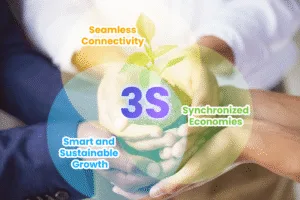
Reflecting this economic importance, the ACMECS Master Plan 2019‑2023 explicitly treats tourism as a cornerstone of integration. It dedicates a section to “smart and responsible tourism,” noting that cooperation on tourism and the “Five Countries, One Destination (5C1D)” conceptwill strengthen people-to-people connectivity, promote mutual understanding and respect for cultural diversity, and advance sustainable development, social inclusion, and regional integration. This also echoes the ACMECS’ concept of promoting public awareness. The three pillars of ACMECS (Seamless Connectivity, Synchronized ACMECS Economies, and Smart & Sustainable ACMECS) build the path through hard connectivity, gather strength through soft connectivity, and breathe soul through smart connectivity, together transforming geographical proximity into a shared prosperity.
In practice, through tourism cooperation, ACMECS is integrating economic development objectives with the construction of a common identity by advancing the movement of people, cultural exchange, infrastructure and institutional connectivity in a mutually reinforcing manner. Through creating tourism routes and cooperation in cultural heritage and ecotourism, ACMECS translates the Mekong region’s diverse and shared civilizational foundations into a tangible and experiential form, thereby continuously strengthening mutual understanding and respect among riparian communities. In this process, tourism not only benefits from improved transport, digital connectivity, and the interoperability of rules and regulations but also feeds back to enhance public recognition and social acceptance of these cooperative achievements. De facto, tourism development has emerged as a key bridge linking hard and soft connectivity, fostering trust, shaping a shared regional narrative, and gradually transforming geographical proximity into public awareness alongside deeper economic integration.
Connectivity Strengths
The Mekong River is often described as the“River of Buddhism.” A powerful basis for a unified brand is the region’s religious corridor connected by Buddhism, such as Bagan in Myanmar, Angkor Wat in Cambodia, Luang Prabang in Laos, Ayutthaya in Thailand, and Hue in Vietnam. Simultaneously, the ACMECS tourism action plan explicitly calls for developing corridor routes connecting ancient capitals and cultural sites, including “Buddhist trails”, as part of the 5C1D campaign.
The joint promotion of Buddhist heritage, natural landscapes and culinary diversity across borders enhances a sense of belonging to a common Mekong civilization. To better connect this shared cultural heritage, the developmental achievements of both hard and soft connectivity are indispensable.
Regarding infrastructure, each member country is strengthening physical links that bind the region. Thailand’s Eastern Economic Corridor (EEC) is a flagship project that includes new transport hubs and tourism facilities. For example, Thailand is building a high-speed rail linking three airports (Bangkok’s new U-Tapao airport, Suvarnabhumi and Don Mueang) and expanding its port capacity; all aimed at integrating the region with global markets. In Laos, till 2024, the China–Laos Railway has already carried over 43 million passengers, dramatically cutting travel times and freight costs. It has “significantly enhanced regional connectivity” and changes Laos from a “landlocked” to “landlinked”. In Cambodia, the opening of the new Siem Reap Angkor International Airport massively boosts capacity. The airport can handle 5-7 million passengers a year with long-haul aircraft, making Angkor far more accessible to international tourists. Vietnam and Myanmar are similar to other members in investing in cross-border highways and bridges to link riparian heritage sites and eco-destinations. In addition, ACMECS is actively developing inland waterways as an integral component of its “hard connectivity” transport infrastructure. In short, the current progress in hard connectivity has begun to shape a three-dimensional land-water-air network,in which each country’s contribution ultimately integrates the region into a seamless tourism system. Concurrently, at the institutional level, ACMECS has advanced tourism-related information sharing, exchanges on service standards, and policy discussions on visa facilitation and border-crossing procedures.
Future Directions
At present, under the ACMECS framework, the promotion of the 5C1D to foster a tangible regional public awareness is already supported by a shared civilizational foundation, solid hard connectivity advantages, and a vast potential base of soft connectivity. Building on existing foundations, ACMECS can deepen regional coordination in five key directions to reinforce its tourism-led integration.
Energy coordination is vital to branding the Mekong as a green destination. Aligned with the ACMECS Master Plan, member states should enhance cross-border power grids and clean transport, such as electric buses, rail, and solar infrastructure. These efforts promote an eco-friendly tourism brand, attract climate finance, and advance the green transition through low-emission transport, renewable energy, and sustainable industries across the subregion.
Technology coordination will drive ACMECS’s digital transformation in tourism. The Master Plan calls for stronger digital infrastructure—broadband, submarine cables, and cybersecurity—to build seamless connectivity. Establishing a “Digital ACMECS Ring” linking data and payment systems will streamline visas and travel services. Enhanced e-governance, smart tourism, and innovation initiatives will further boost secure, inclusive cross-border travel and support ACMECS’s broader goal of digital resilience.
Product coordination integrates the Mekong countries into one seamless tourism brand. ACMECS promotes joint branding, shared quality standards, and cross-border routes under the 5C1D concept. Coordinating itineraries, hotel grading, and guide training, alongside linked marketing through economic zones, will create unified tourism products. This integration amplifies regional attractions, boosts investment in local supply chains, and enables joint promotion of smaller destinations through major hubs.
Talent coordination enhances the Mekong’s tourism workforce through cross-border training, mobility, and public–private partnerships. Initiatives like Thailand’s New Economy Academy and ACMECS’ smart education can expand joint certificates, apprenticeships, and guide training will harmonize standards, cultivate high-quality human resources, improve service quality, and foster a skilled, mobile workforce capable of advancing ACMECS’s smart and sustainable tourism vision.
Institutional advantage coordination urges ACMECS to use its multilateral flexibility and align with the UN, ASEAN, and other Mekong frameworks. Expanding seamless travel by reviving and extending the ACMECS single-visa into a full regional scheme with mutual document recognition would realize “One Destination.” Such integration strengthens intra-Mekong cooperation, simplifies border procedures, and enhances collective resilience and hedging power amid growing external competition.
In conclusion, while rooted in tourism, ACMECS integration across each cooperative sector is an essential component in cultivating public awareness. The five areas of coordination outlined above are not only the future directions for building the 5C1D but also represent collective efforts by regional countries to address complex development challenges—such as climate change, the digital divide, poverty, migration and employment issues, and an increasingly uncertain international environment. Through these joint efforts, resolving development dilemmas becomes a sustainable way for nurturing essential public awareness.
Dr. Duan Haosheng
Social Policy and Development International Program
Faculty of Social Administration
Thammasat University