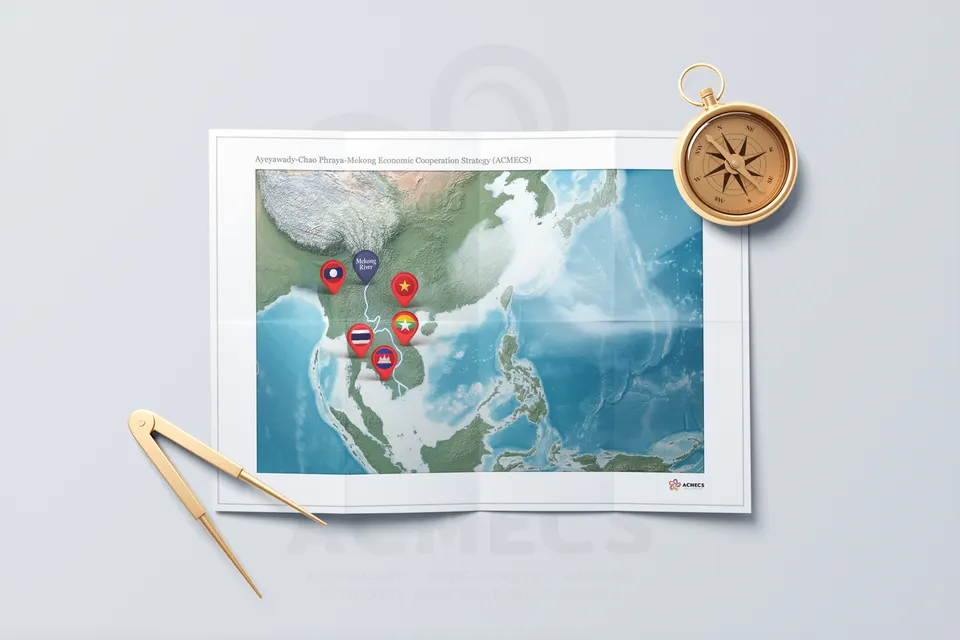
A folded map of the Mekong sub-region with pins for the five ACMECS member countries, beside a brass compass

From Concept to Reality: The Birth of ACMECS

ACMECS, founded in 2003, aims to stimulate economic cooperation and development among countries connected by the Ayeyawady, Chao Phraya, and Mekong rivers. Originating from the Special ASEAN Summit on SARS, the Bagan Declaration in 2003 formalized ACMECS’s commitment to economic growth, social progress, and cultural development through collaborative efforts among Cambodia, Lao PDR, Myanmar, Thailand, and Viet Nam. Expansion and support from key global development partners have further strengthened ACMECS’s impact.
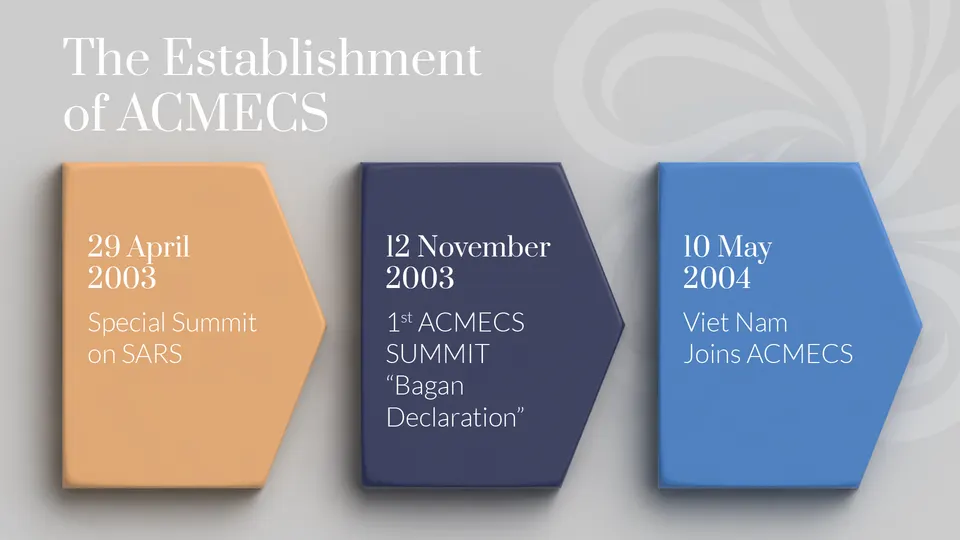
Timeline: 29 April 2003 Special Summit on SARS; 12 November 2003 first ACMECS Summit and the Bagan Declaration; 10 May 2004 Viet Nam joins ACMECS

The Establishment of ACMECS

Building ACMECS’s Foundation: The Bagan Declaration

The Bagan Declaration, adopted at the summit, laid the groundwork for ACMECS, emphasizing principles to enhance competitiveness, facilitate industry relocation, create employment, and promote peace and stability across member countries. This foundational document set the stage for cooperation in Trade and Investment Facilitation, Agricultural and Industrial Cooperation, Transport Linkages, Tourism Cooperation, and Human Resources Development. The plan outlined 42 common projects and 224 bilateral projects, aimed at fostering regional development with support from loans, grants, and technical assistance.

ACMECS Summit 1 protocol to the Bagan Declaration on Admission of Vietnam

The Bagan Declaration

Vision 2023: ACMECS Master Plan for a Dynamic Future

At the 8th ACMECS Summit in Bangkok, Thailand, on June 16, 2018, member countries adopted the ACMECS Master Plan 2019-2023, focusing on sustainable development, technological innovation, and regional integration. The plan is structured around three pillars:

  1. Seamless ACMECS: Promoting connectivity through multi-modal transport links.
  2. Synchronized ACMECS: Enhancing software connectivity, focusing on trade, investment, industrial cooperation, and financial integration.
  3. Smart and Sustainable ACMECS: Developing human capital in strategic areas to ensure long-term sustainability and growth.

Click here to view ACMECS Master Plan: Seamless ACMECS, Synchronized ACMECS, and Smart and Sustainable ACMECS.

Expanding Horizons: Engagement with the Development Partners

ACMECS acts as the “connector” to bridge and align strategic interests of the sub-region’s architecture with Mekong-led development agendas in setting direction for cooperation. ACMECS also promotes constructive engagement with six development partners, namely, Australia, China, India, Japan, the Republic of Korea, and the United States.

ACMECS exemplifies sub-regional cooperation within ASEAN, navigating challenges and seizing opportunities through strategic initiatives and partnerships. As a dynamic force in a globalized world, ACMECS continues to pave the way towards shared prosperity and sustainable growth.

A fisherman casting a net from a wooden boat on the Mekong at sunrise

Fisherman of mekong river in action when fishing of sunrise
Topics
ACMECSAgricultural CooperationASEANAyeyawady-Chao Phraya-Mekong Economic Cooperation StrategyBagan DeclarationDevelopment PartnersEconomic CooperationHuman Resources DevelopmentIndustrial CooperationMultidimensional ConnectivityRegional IntegrationSoutheast AsiaSustainable DevelopmentTechnological InnovationTourism CooperationTrade and InvestmentTransport Linkages

More articles

See all
Long-tail boats moored along a river beside a hillside village, with the title “ACMECS Roles in Supporting ASEAN Integration”
Article

ACMECS Roles in Supporting ASEAN integration

ACMECS has effectively coordinated with other subregional mechanisms by positioning itself as an open platform highly aligned with ASEAN Centrality. … Such a coordination model not only prevents the fragmentation of the regional architecture but also ensures that member states, while efficiently tapping into international resources, can maintain a balance between autonomy and development cooperation through a unified voice.

Misty mountains rising above the Mekong River, with the title “ACMECS Development Fund: Cooperation-Driven Mechanism for Shared Prosperity”
Article

ACMECS Development Fund: Cooperation-Driven Mechanism for Shared Prosperity

The Fund is also important because it provides a flexible framework for cooperation with development partners. Partners can support ACMECS in several ways, such as funding specific projects, creating country-focused funding arrangements that match their own priorities, or contributing to a common regional pool. This flexibility makes the Fund attractive to external partners and helps align their expertise with the needs of the Mekong subregion.

Cargo boats on the Mekong at sunset, with the title “Example and Success of Ongoing Projects in ACMECS Framework”
Article

Example and Success of Ongoing Projects in ACMECS Framework

At the local and societal level, the benefits of ACMECS projects become more visible in everyday life. Cooperation in sectors such as education, health, energy, and climate adaptation further strengthens social well-being and community resilience. In particular, the growing emphasis on ‘soft connectivity’—including knowledge exchange, human resource development, and people-to-people links—ensures that regional cooperation translates into inclusive and people-centered development.